
From Sketch to Skyline: The Essential Guide to Integrated Building Design Services
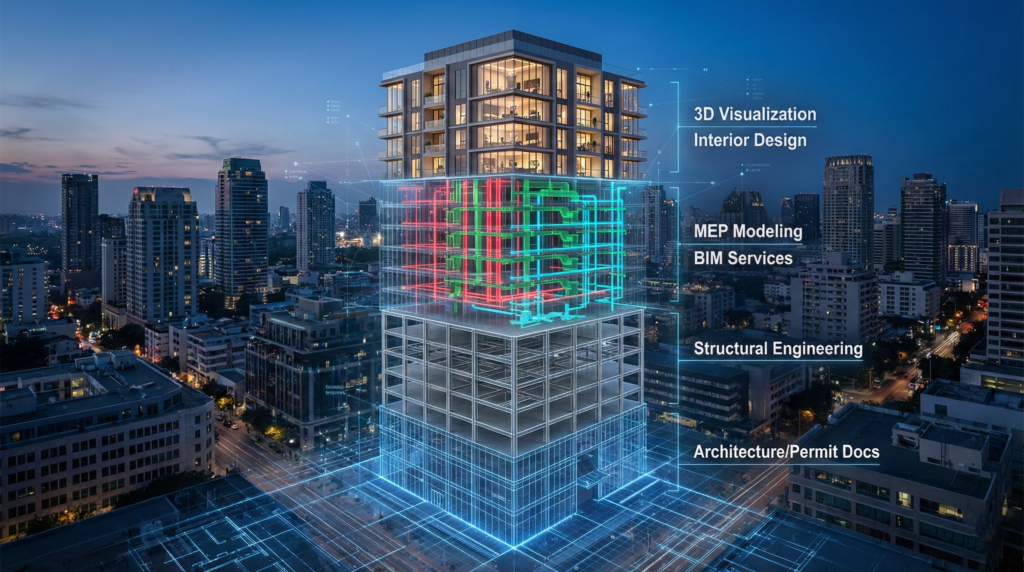
Welcome to WordBuilding today is more complex than ever. Discover how integrated documentation, BIM, and visualization services turn abstract ideas into concrete reality, saving time and money along the way.Press. This is your first post. Edit or delete it, then start writing!
Every iconic structure starts with a simple idea. But the journey from that initial spark to the ribbon-cutting ceremony is a complex maze of regulations, engineering challenges, and aesthetic decisions. In modern construction, success isn’t just about having a good design; it’s about having a flawless, integrated set of data that guides the project every step of the way.
A successful project requires a holistic approach where art meets science, and blueprints meet digital twins. Here is a breakdown of the essential services that bridge the gap between concept and construction.
1. The Foundation: Architecture and Structural Documentation
Before anything else, the vision needs a rigorous technical framework.
- Architecture Documentation: This is the translation of the design intent into technical language. It details the spatial relationships, dimensions, and overall form of the building. It’s the “what” and “where” of the project.
- Structural Engineering Modeling and Documentation: If architecture is the skin, structure is the skeleton. This service ensures the building can stand up to gravity, wind, and seismic forces. By modeling steel, concrete, and timber beams accurately, we ensure safety and stability are baked into the design from day one.
2. The Central Brain: Building Information Modeling (BIM)
Gone are the days of unrolling hundreds of 2D drawings to find a conflict. BIM Services have revolutionized the industry.
BIM creates an intelligent 3D model that serves as the single source of truth for the entire project. It isn’t just a pretty picture; it’s a database containing information about every door, wall, and pipe. BIM allows architects, engineers, and contractors to collaborate simultaneously, spotting clashes before ground is ever broken.
3. The Vital Systems: MEP Modeling
A building is useless without its “organs”—the systems that make it habitable. Mechanical, Electrical, and Plumbing (MEP) modeling and documentation involve intricately designing the HVAC ducts that keep you cool, the wiring that powers your lights, and the plumbing that brings clean water. Integrating these complex highways into the BIM model prevents the expensive nightmare of pipes colliding with beams on the construction site.
4. Visualizing the Dream: Interiors, Animation, and Presentation
Stakeholders, clients, and investors need to feel the space before it exists.
- 3D Visualization and Animations: These are powerful tools that turn technical data into photorealistic renders or fly-through videos. They are crucial for marketing and design approval.
- Interior Design Documentation: This drills down into the finishes, furniture, lighting fixtures, and material palettes that define the user experience inside the building.
- Presentation Drawings: These are polished, stylized versions of architectural plans designed specifically to communicate the design narrative clearly and persuasively to non-technical audiences.
5. Crossing the Finish Line: Permit and Construction Documents
All the modeling in the world means nothing if you can’t legally build it. Permit and construction documents are the final, authoritative set of drawings and specifications submitted to local authorities for approval and used by contractors to build. They are the culmination of all previous steps, ensuring code compliance and constructability.
The Value of Integration
By utilizing these services under one integrated umbrella, you move beyond disconnected drawings. You gain a cohesive digital ecosystem that minimizes errors, provides accurate material take-offs, streamlines communication, and ultimately, delivers a better building on time and on budget.
Hi, this is a comment.
To get started with moderating, editing, and deleting comments, please visit the Comments screen in the dashboard.
Commenter avatars come from Gravatar.